

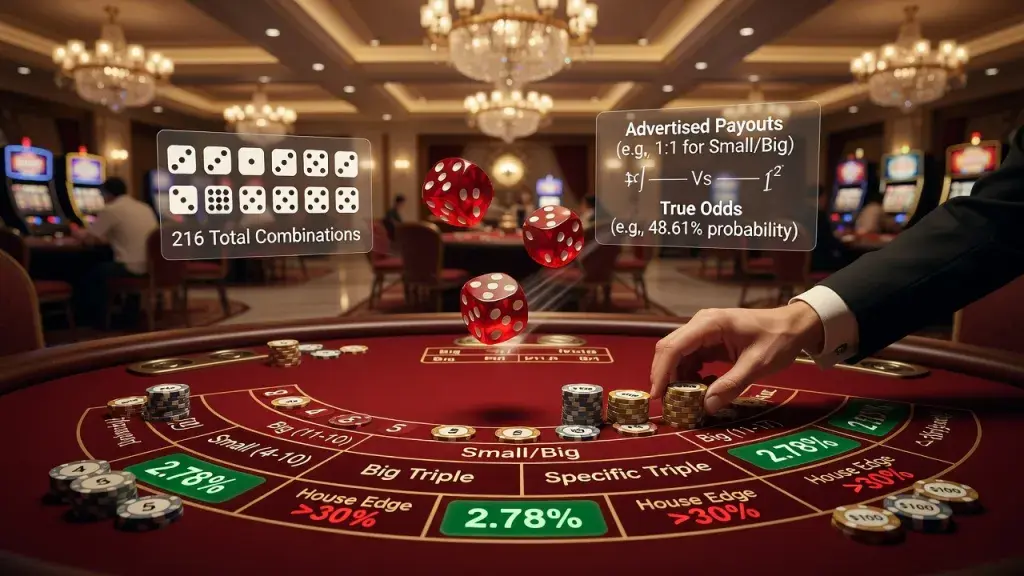
A single roll of three dice produces 216 possible combinations, yet most Sic Bo tables push players toward bets with house edges above 15 percent. That gap between what looks exciting and what actually pays fairly is the entire game in miniature. Sic Bo rewards players who read the odds table before they read the felt, and punishes those who bet on instinct alone.
This distinction matters because Sic Bo layouts are deliberately crowded with tempting options - triple sixes, specific number combinations, exact totals - all dressed up with flashy payouts that rarely reflect their true probability. Understanding casino Sic Bo odds means separating marketing from mathematics. For readers who want a fast reference point before diving into strategy, a breakdown of best sic bo bets by odds offers a useful starting comparison of house edges across bet categories.
What follows is a structured look at how odds actually work in Sic Bo, which bets deserve a place in your rotation, and how to build a betting approach around probability rather than temptation. The goal is not to promise guaranteed wins - no dice game allows that - but to help you lose less over time and capitalize when the odds genuinely favor a bet.
Understanding Sic Bo Odds: Why They Matter More Than Payouts
Every bet on a Sic Bo table has two numbers attached to it: the payout it advertises and the probability of it actually landing. Casinos design the game so these two numbers rarely align in the player's favor. A bet paying 60-to-1 sounds thrilling, but if the true odds of winning are closer to 215-to-1, the advertised payout is covering only a fraction of the real risk.
How House Edge Is Calculated in Sic Bo
House edge represents the percentage of every wagered dollar the casino expects to keep over the long run. In Sic Bo, this figure swings wildly depending on the bet - from around 2.78 percent on the safest wagers to over 30 percent on the riskiest single-number combinations. This spread is unusually wide compared to other table games, which is exactly why bet selection matters so much here.
Why Some Bets Look Better Than They Are
Specific triples and exact number combinations dominate the visual center of the table because they generate excitement and repeat action. Their payouts appear generous - often 30-to-1 or higher - but the actual probability of hitting them is so low that the math heavily favors the house. Recognizing this pattern is the first real step toward a sound Sic Bo betting strategy.
Reading the Odds Table Before You Sit Down
Most casinos post a payout chart directly on the table or in the rules card. Cross-referencing that chart against known probabilities takes a few minutes and pays dividends for the rest of the session. Players who skip this step tend to bet on excitement; players who read it tend to bet on value.
- Small and Big bets: house edge near 2.78%
- Any Triple: house edge often above 30%
- Specific Triple: even higher, despite large payouts
- Total bets: edge varies significantly by total value
Best Sic Bo Bet Types Ranked by Odds
Not all bets are created equal, and ranking them by expected value rather than payout size changes how a session should be played. This section breaks down the primary bet categories by how favorable their odds actually are.
Small and Big Bets: The Foundation of Low-Risk Play
Small (totals 4-10) and Big (totals 11-17) bets pay even money and carry one of the lowest house edges on the table, provided no triple appears. These bets exclude any roll where all three dice match, which is the mechanism that gives the house its slim advantage. For players prioritizing longevity over jackpot dreams, these remain the most defensible bets on the layout.
Single Number Bets: Moderate Risk, Moderate Reward
Betting on a single number appearing on at least one die offers payouts scaled to how many dice show that number - 1-to-1 for one die, 2-to-1 for two dice, and 12-to-1 for all three. The house edge here sits in the middle range, making it a reasonable choice for players who want more action than Small/Big without diving into high-risk territory.
Combination and Domino Bets: Balanced Middle Ground
Combination bets, where a player picks two specific numbers to appear together, offer a fixed payout (commonly 6-to-1) with a house edge that's higher than Small/Big but noticeably lower than triples. These bets add variety without wrecking the bankroll.
Triple and Specific Triple Bets: High Payout, High Regret
Any Triple and Specific Triple bets are the loudest options on the table, promising payouts of 30-to-1 or more. Their probability of hitting is so slim that the house edge routinely climbs past 18 percent for Any Triple and even higher for a Specific Triple. These are best treated as occasional novelty bets, not core strategy.
Odds-Based Sic Bo Betting Strategy: Building a Smarter Approach
A working strategy in Sic Bo isn't about predicting dice - that's impossible - it's about allocating bets so the mathematical damage is minimized while still leaving room for meaningful payouts.
Anchoring Your Bets Around Small and Big
Using Small or Big as a base bet gives a session structure. Because the house edge is low and payouts are even money, this bet stabilizes a bankroll while other, riskier bets are layered on top for variety.
Layering Secondary Bets for Balanced Exposure
Once a base bet is set, adding a single-number bet or a combination bet introduces upside without significantly increasing overall risk. This layering approach means a win on the base bet is likely on many rolls, while occasional bigger payouts come from the secondary wagers.
Avoiding the Trap of Chasing Triples
The visual appeal of triple payouts pulls many players into repeated betting on Any Triple or Specific Triple, especially after a near-miss. This is a costly habit. Statistically, near-misses have no bearing on future rolls, and repeated triple bets erode a bankroll faster than almost any other pattern of play.
Setting Session Limits Based on Bet Volatility
Because Sic Bo bets vary so much in volatility, a fixed loss limit should be adjusted depending on which bets dominate a session. A session built around Small/Big can tolerate a longer play window than one built around high-variance triples, where swings happen fast in both directions.
Casino Sic Bo Odds: Comparing Table Variations
Not every Sic Bo table runs identical rules, and small variations in payout structure can shift the house edge meaningfully.
Standard Payout Tables vs. Enhanced Payout Tables
Some casinos offer slightly enhanced payouts on specific number or combination bets to attract players. These differences are often small - a single unit of payout - but compounded over many rolls, they measurably change long-term expected loss.
Live Dealer Sic Bo vs. Digital RNG Versions
Live dealer tables and digital random-number-generator versions use identical mathematical structures, since the dice outcomes follow the same probability regardless of physical or virtual rolling. The difference lies in pacing and the ability to observe patterns over a session, which affects player psychology more than actual odds.
Why Reading the Payout Chart at Each New Table Matters
Because payout structures aren't universal, a strategy that worked at one table might carry a different house edge at another. Checking the posted chart before placing a first bet takes seconds and prevents unpleasant surprises later.
Odds-Based Sic Bo Betting Tips for Consistent Play
Beyond bet selection, a handful of practical habits separate disciplined players from those who bet reactively.
Track Which Bets You're Actually Placing
Keeping mental or written note of bet types placed during a session reveals patterns - like an unconscious pull toward high-risk triples - that are easy to correct once identified.
Use Flat Betting Instead of Progressive Systems
Progressive betting systems, which increase wager size after losses, don't change the underlying odds of Sic Bo and can accelerate losses during a cold streak. Flat betting, where wager size stays consistent, aligns better with a game where each roll is independent of the last.
Treat High-Payout Bets as Occasional, Not Habitual
There's nothing wrong with placing a Specific Triple bet occasionally for the thrill of a big payout, as long as it's understood as entertainment spending rather than a core part of strategy.
Frequently Asked Questions
What is the safest bet to place in Sic Bo?
Small and Big bets carry the lowest house edge on most tables, generally around 2.78 percent, because they pay even money and only lose when a triple appears. They're the closest thing to a "safe" bet in a game built around high-variance outcomes.
Are Specific Triple bets ever worth placing?
They're worth placing only as occasional, small wagers for entertainment value. The payout looks attractive, but the probability of hitting a specific triple is extremely low, giving this bet one of the highest house edges on the table.
Does the number of dice showing a chosen number affect payout?
Yes. Single number bets pay more when multiple dice show the chosen number - typically 1-to-1 for one match, 2-to-1 for two matches, and 12-to-1 if all three dice match. This scaling makes single number bets a reasonable middle-risk option.
Can betting systems improve my odds in Sic Bo?
No betting system changes the underlying probability of dice outcomes, since each roll is independent. Progressive systems can even increase the risk of larger losses during a losing streak, which is why flat, consistent wagering tends to hold up better over time.
Is live dealer Sic Bo different from digital versions in terms of odds?
The mathematical odds are identical between live dealer and RNG-based digital Sic Bo, since both rely on the same probability distribution across 216 possible dice combinations. The experience differs in pacing and visual engagement, not in the actual house edge.
How often should I check a table's payout chart?
Every time you sit down at a new table, since payout structures for combination and specific number bets can vary slightly between casinos. A quick check ensures your strategy matches the actual odds being offered rather than assumptions from a previous session.

